
Skip to content

Infrastructure

Rajpath Club's 186-Acre Dholera Campus: What It Signals for the Region

Siddharth Patel

Property Owner

Published 16 September 2026 · Updated 3 October 2026 · 4 min read

Rajpath Club's 186-Acre Dholera Campus: What It Signals for the Region

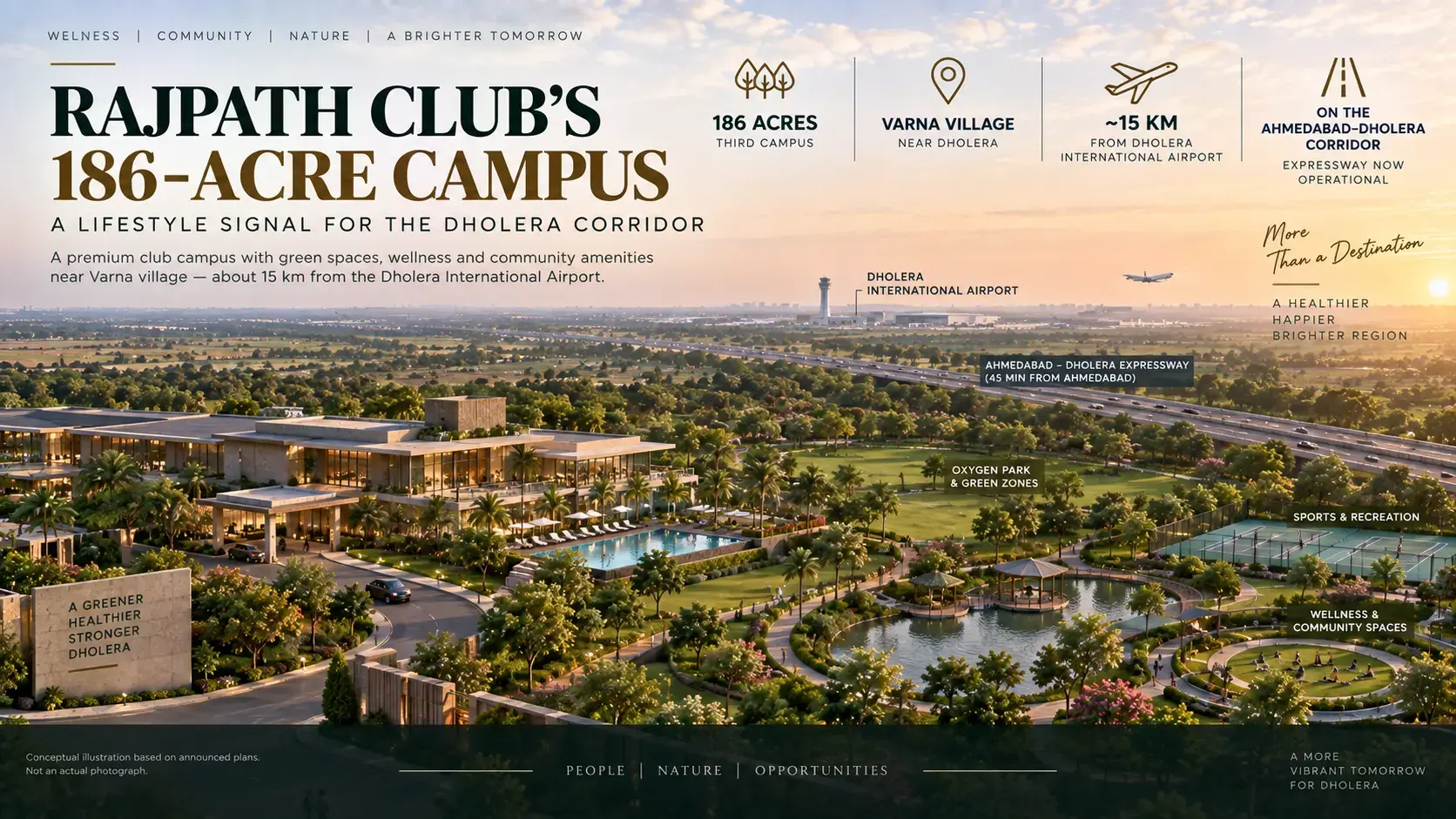
Rajpath Club has announced a 186-acre third campus near Varna village on the Ahmedabad–Dholera corridor — a lifestyle and wellness development that signals growing institutional confidence in the corridor.

A different kind of announcement for the corridor

Most of the attention on the Dholera corridor has come from industrial and infrastructure announcements — semiconductor fabs, aircraft assembly, data centres, power projects. These are the projects that dominate headlines and conversations about the region's future, and understandably so.

The Rajpath Club campus announcement is a different kind of signal. It brings lifestyle and wellness into the picture — the sort of development that usually follows, rather than drives, a region's growth. The fact that one is now arriving alongside the industrial activity is itself worth noticing.

What has been announced

Rajpath Club is a well-known Ahmedabad club with a long-standing reputation for sports, wellness and community facilities across its existing campuses. Its decision to add a third campus on the Ahmedabad–Dholera corridor places the club squarely in the path of the region's emerging development.

  • 186-acre third campus for Rajpath Club near Varna village
  • Located near Varna village, close to Vataman Chowkdi along the Ahmedabad–Dholera corridor
  • Planned facilities include an oxygen park, wellness and community amenities
  • Directly served by the Ahmedabad–Dholera Expressway, operational since March 2026 — roughly 45 minutes from Ahmedabad

The corridor behind the decision

A decision like this is not made in isolation. A club committing to a large lifestyle campus has to consider how members, visitors and staff will reach it — which brings the corridor's connectivity back into focus.

The expressway already delivers a drive of roughly 45 minutes from Ahmedabad. The Dholera International Airport, on the same corridor, is nearing completion with passenger operations targeted for the end of 2026, subject to DGCA licensing. In this context, the logistics of a premium campus become manageable — that is the practical point of corridor development.

Lifestyle development alongside industry

Premium lifestyle and community facilities do not compete with industrial anchors — they complement them. An airport, an expressway and large-scale industry bring people and economic activity to a region; clubs, parks and wellness spaces address the standards of living and recreation that a mature area is expected to offer.

For the corridor, the campus adds variety to the development picture. It is evidence that the region is being approached as more than a production zone — as a place where institutions are willing to invest in long-lived community assets.

What this does and does not prove

It is worth being precise about what an announcement like this does not mean: a club campus is not evidence that any particular parcel will appreciate, and it is not a measure of property outcomes. Background developments cannot be converted into guarantees about land value.

What it does demonstrate is that established, serious institutions are taking the corridor seriously beyond industry alone. When a recognised Ahmedabad club commits to a 186-acre site on a corridor still at an early stage, that is a form of institutional confidence in the area's longer-term trajectory.

Weighing a lifestyle signal against land value

For buyers evaluating land in and around the Rojka area, announcements like this form part of the wider context around the corridor. Lifestyle activity alongside industrial anchors, connectivity and the airport suggests the region is being built around more than a single project — spanning industry, infrastructure and now community-scale amenities.

It is worth being straight about how much weight this carries. A private campus signals developer and institutional confidence in the corridor, but institutional and lifestyle projects do not generate the employment or freight volumes that move industrial land values. The announcement is better read as confirmation that the corridor is becoming a place people want to be near, than as a pricing input. Buyers weighting lifestyle signals should do so after title, access and land classification, not instead of them.

Sources & References

Figures and developments cited in this article are drawn from the following published reports. Each link opens the source publication directly.

Keep Reading

All Articles
CallWhatsAppSite Visit