
Skip to content

Land

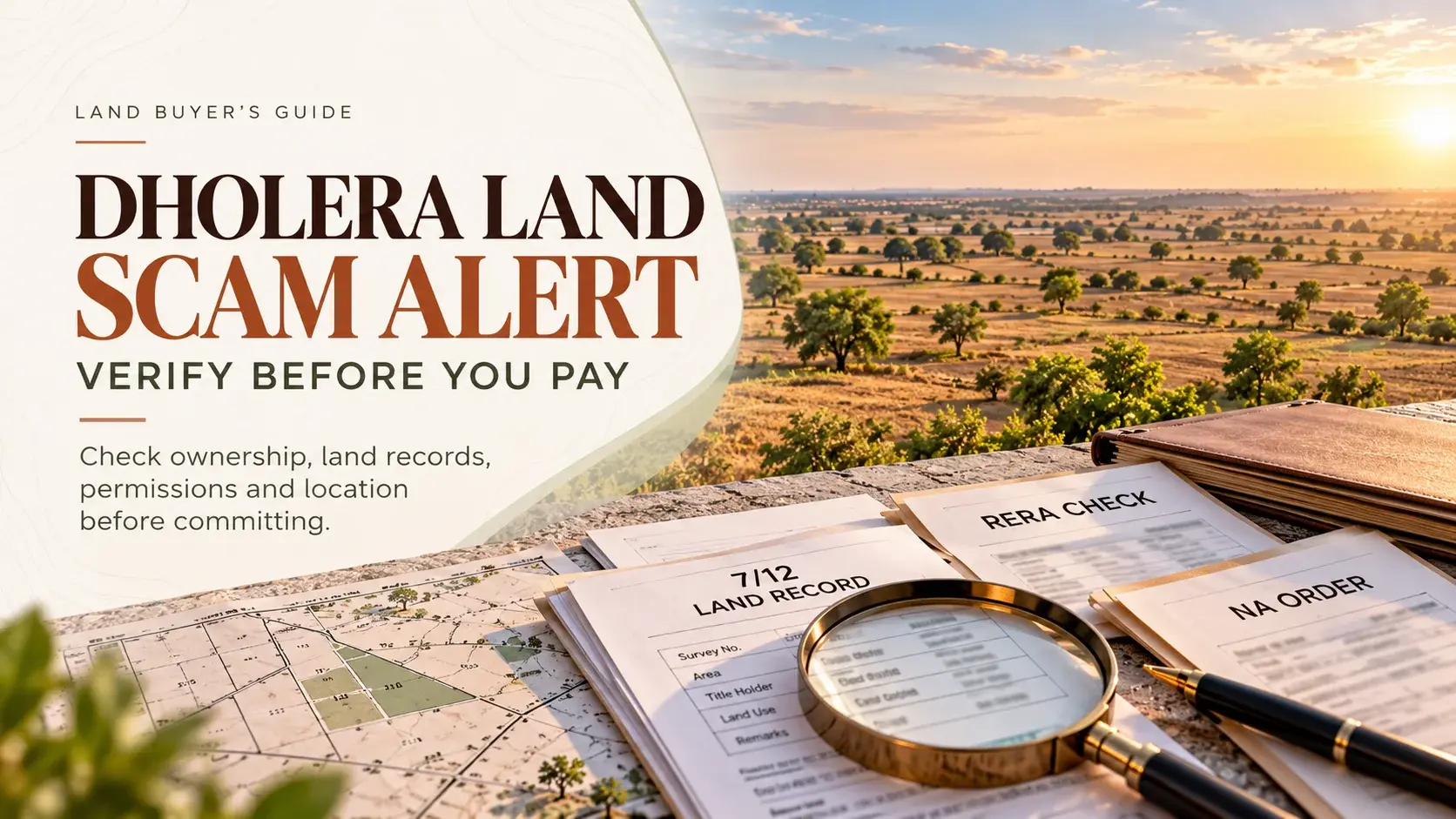
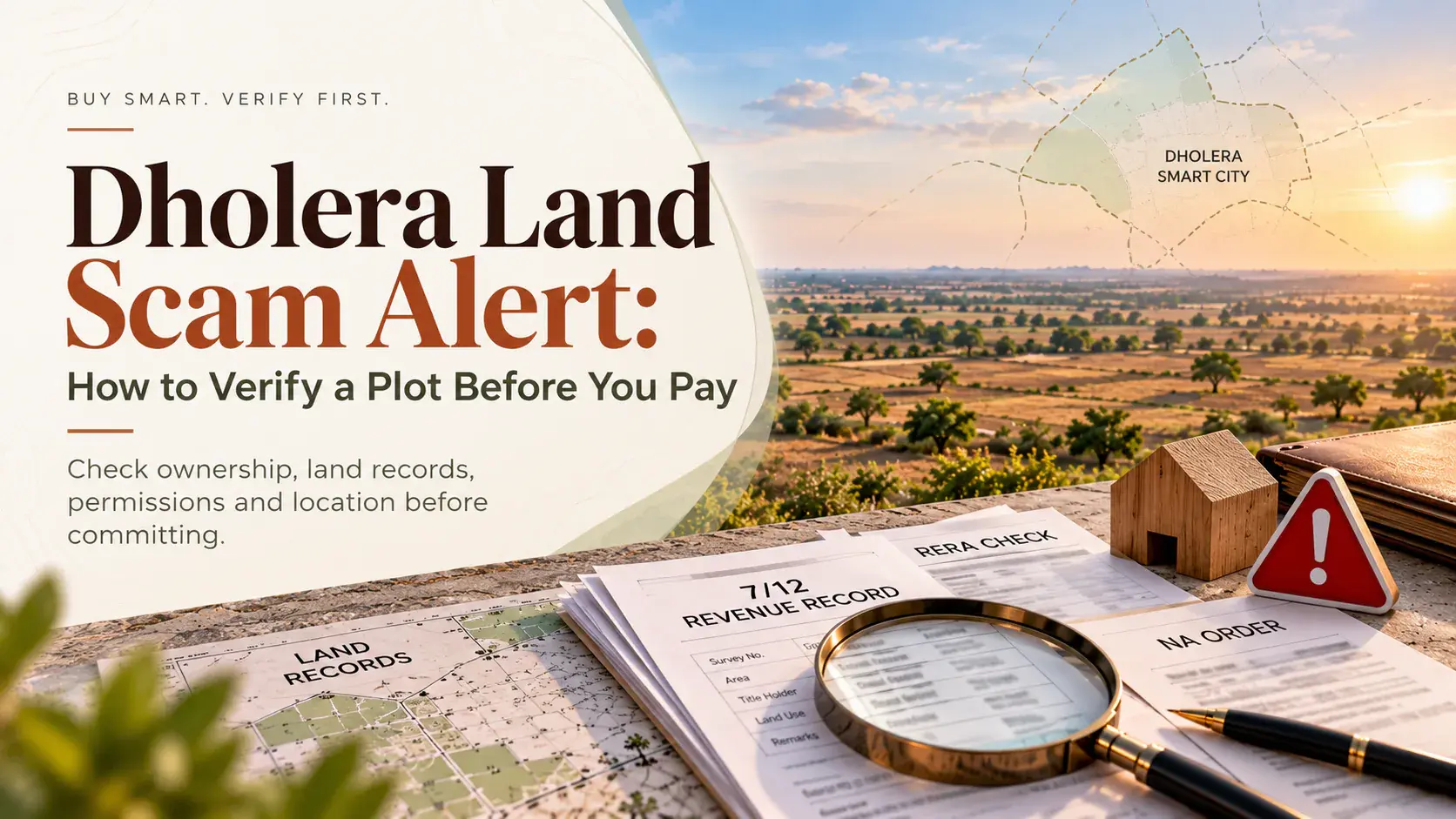
Dholera Land Scam Alert: How to Verify a Plot Before You Pay

Siddharth Patel

Property Owner

Published 17 October 2026 · 7 min read

Dholera Land Scam Alert: How to Verify a Plot Before You Pay

Enforcement action against investment schemes marketed under the Dholera name has focused buyers on one question: how do you tell a genuine plot from a trap? This guide sets out the checks that separate the two.

Why verification matters more in a rising region

Regions that attract serious infrastructure investment also attract people who trade on the name rather than the asset. Dholera is a genuine programme with real projects under construction — and it is precisely that credibility that makes the name worth borrowing.

In 2026, India's Enforcement Directorate filed a charge sheet in an investigation into investment schemes that raised money by marketing plots under the Dholera Smart City name. That case is not evidence that the region is unsafe; it is evidence that paperwork, not enthusiasm, is what protects a buyer.

This guide is about method: the checks that separate a genuine, verifiable plot from a promise. None of them requires special access — only the discipline to verify before paying.

Five red flags that should stop a purchase

Problem deals tend to share the same handful of features. Any one of them is a reason to slow down; two or more should end the conversation.

  • Assured or guaranteed returns — land does not pay a fixed monthly income, and a parcel sold with a promised payout is being marketed as an investment product rather than as land
  • No RERA registration number — a project within the Act's scope must be registered with GUJRERA, and a suggestion that the rules do not apply yet is not a registration number
  • Claims of walking distance to the Tata fab or the airport — proximity is easy to assert in a brochure and rarely supported by the record
  • Only scanned copies of documents — originals, or certified copies, should be available for your own lawyer to inspect
  • Pre-launch pricing with no NA permission and no NOC — without them you may be buying agricultural land you cannot legally build on

Step one: verify the project on GUJRERA

Gujarat's RERA portal, gujrera.gujarat.gov.in, lets anyone search registered projects and promoters and view the details a promoter has disclosed. The registration number is the test: it either exists there, or it does not.

It is worth being precise about what RERA does and does not cover. RERA governs the promotion and sale of real-estate projects; it is not a certificate that the land under any particular parcel is clear, and it does not apply to every transaction in the way some sellers imply. Treat it as one verified layer, not the whole picture.

Step two: verify the land on the revenue records

Land in Gujarat is described by revenue records that anyone can pull from the official portal, anyror.gujarat.gov.in. Two documents do most of the work, together with the chain of title:

  • The 7/12 extract (satbara utara) — the record of rights and encumbrances over a survey number: who holds it, the area, and any charge or acquisition noted against it
  • The 8-A extract — the account of everything a holder owns in the village, which is how ceiling limits and related claims become visible
  • The chain of title and the mutation (ferfar) entries — which connect the current holder to the previous one, transaction by transaction

Step two, continued: read the record against the map

Registration of a sale deed and mutation of the record are two different steps, and a sale can be registered without the revenue record ever changing. Confirm that the mutation has been certified, not merely applied for.

Then confirm the survey number, the area and the boundary against the official map. A mismatch between the advertisement and the record is a question to settle before money moves, not after.

Step three: verify the permission and the location

Two things decide what a parcel can legally be used for and where it actually sits: its classification, and its position relative to the notified region.

Agricultural land in Gujarat can be put to non-agricultural use only after a Non-Agricultural (NA) order is granted, and an NA order carries conditions that can lapse. Building on agricultural land without a valid order is not a paperwork shortcut — the structure is unauthorised. Ask to see the order and check that its conditions are still satisfied.

The second point is the one that catches buyers most often. Dholera SIR is a notified region with defined boundaries. Land inside it carries the authority's planning and infrastructure obligations; land outside it does not. Marketing rarely makes the distinction, and some of the cases reported in the press concern parcels sold under the Dholera name that sit outside the notified boundary. Ask for the Final Plot or survey position, and confirm it against the official DICDL or DSIRDA records rather than a brochure.

A 2026 Gujarat High Court ruling on an Ahmedabad–Dholera Expressway land deal is a reminder that even the records can be manipulated: the court found that altered village maps and an unusually fast NA conversion had supported a fraudulent sale. That is why every check belongs against the primary source, at the time of the transaction — never a screenshot or a forwarded PDF.

The questions to ask before any payment

If you take nothing else from this article, take this list. A transparent seller will welcome it.

  • What is the RERA registration number, and can I find the project on gujrera.gujarat.gov.in?
  • What is the survey number and Final Plot position, and where does the parcel sit relative to the notified SIR boundary?
  • Are the 7/12 and 8-A extracts current, and has the mutation been certified?
  • What is the land's classification, and is there a valid NA order for the intended use?
  • Can my own lawyer inspect the original title documents before I commit?
  • What does the land look like on the ground, and how is it accessed?

Where this leaves a serious buyer

None of these checks is exotic, and none requires a connection inside the system. They are the ordinary steps that separate a parcel with a verifiable record from a pitch with a photograph attached — and they are the reason a genuine seller has nothing to hide.

Buying directly from a seller who answers these questions without hesitation is a different experience from buying a promise. For land in and around the Rojka area, the owner discusses the specific parcel — its records, its access and its position — directly during enquiry, which is where these questions belong.

Keep Reading

All Articles
CallWhatsAppSite Visit