
Skip to content

Infrastructure

Ahmedabad–Dholera Semi-High-Speed Rail: Rs 18,901 Crore Tender Explained

Siddharth Patel

Property Owner

Published 12 September 2026 · Updated 3 October 2026 · 7 min read

Ahmedabad–Dholera Semi-High-Speed Rail: Rs 18,901 Crore Tender Explained

A Rs 18,901 crore EPC tender puts the Ahmedabad–Dholera semi-high-speed rail into contracting — construction and commissioning run to around 2030-31.

A rail corridor moving from approval to execution

The most significant transport development announced for the Dholera region is the semi-high-speed rail corridor linking Sarkhej, on the western edge of Ahmedabad, with the Dholera Special Investment Region.

The project received Cabinet clearance earlier in 2026, and in August 2026 Western Railway issued a massive engineering, procurement and construction (EPC) tender for the corridor. Issuing a tender is the clearest sign yet that the project is shifting from planning and approval into the contracting phase.

The corridor in numbers

The scale of the rail project signals how seriously the region's connectivity is being taken.

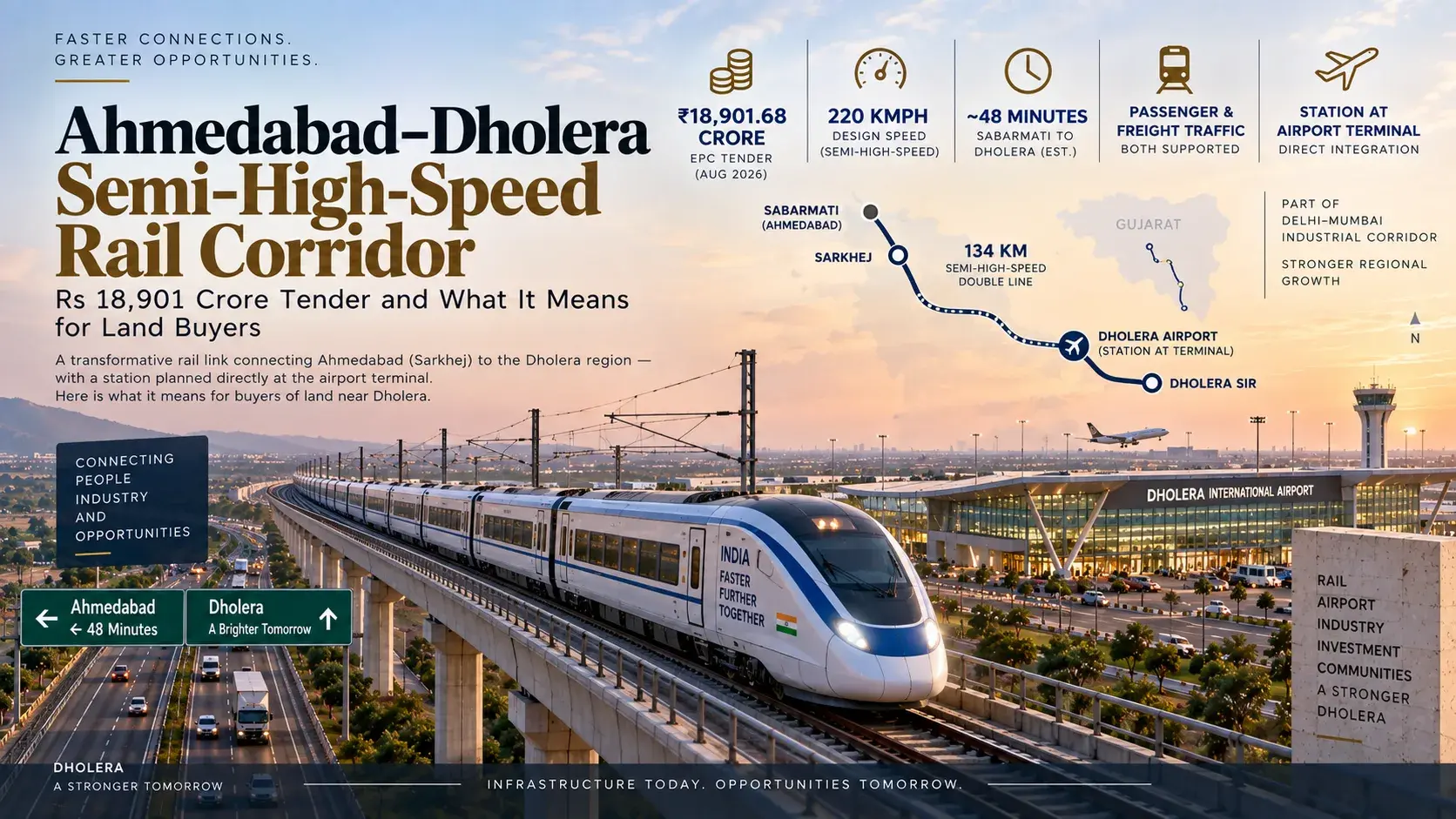
  • Around Rs 20,667 crore sanctioned for the corridor by the Union Cabinet
  • A Rs 18,901.68 crore EPC tender floated by Western Railway in August 2026
  • Design speed of roughly 220 kmph, with operations expected at ~200 kmph — semi-high-speed class
  • Roughly 134 km from Sarkhej to Dholera, with officials citing ~34 minutes from Sarkhej and ~48 minutes from Sabarmati
  • Built to carry both passenger and freight traffic
  • A station positioned directly adjacent to the Dholera International Airport terminal

A direct terminal link to the airport

A distinctive feature of the corridor is its integration with the Dholera International Airport: the station entry point is planned directly beside the airport terminal. Officials have indicated that a passenger travelling from Ahmedabad would be able to step from the high-speed train straight into the terminal.

That design makes the corridor part of a genuinely multi-modal hub — high-speed rail, the expressway and the airport working together as the region's entry point.

Part of the wider industrial corridor

Dholera is positioned as a principal investment region within the Delhi–Mumbai Industrial Corridor (DMIC), India's flagship industrial development initiative. A dedicated rail link strengthens the corridor's freight and commuter logic — moving goods between Ahmedabad, the region's industrial zones and the wider DMIC network.

For the region's semiconductor and manufacturing ecosystem, reliable rail freight connects production to markets — one more reason the project features prominently in conversations about Dholera's industrial future.

Timeline and what to expect

An EPC tender means authorities are selecting construction partners — a real step forward, but not completion. Analysts covering the corridor consistently caution that actual construction and commissioning will unfold over a multi-year horizon, with completion widely expected around 2030–31.

For buyers and observers, it is useful to keep the three stages separate: announced projects, projects under active construction, and services fully operating. Following official announcements keeps expectations anchored to what is actually happening.

Why a tender is not yet a railway

Rail connectivity shapes long-term interest in surrounding land — through easier commutes, freight movement and industrial activity. For the area around Rojka, a rail corridor to Ahmedabad is additional regional context that serious buyers weigh alongside the airport, the expressway and the industrial ecosystem.

The gap between a tender and a working line is the most important thing to understand here. A Rs 18,901 crore EPC tender means contracts are being awarded; construction and commissioning are still expected to run to around 2030-31. For anyone evaluating land today, this is a long-dated factor rather than an immediate one. Rail corridors also tend to lift the areas that actually gain a station, so value concentrates around those nodes rather than spreading evenly along the route.

Keep Reading

All Articles
CallWhatsAppSite Visit